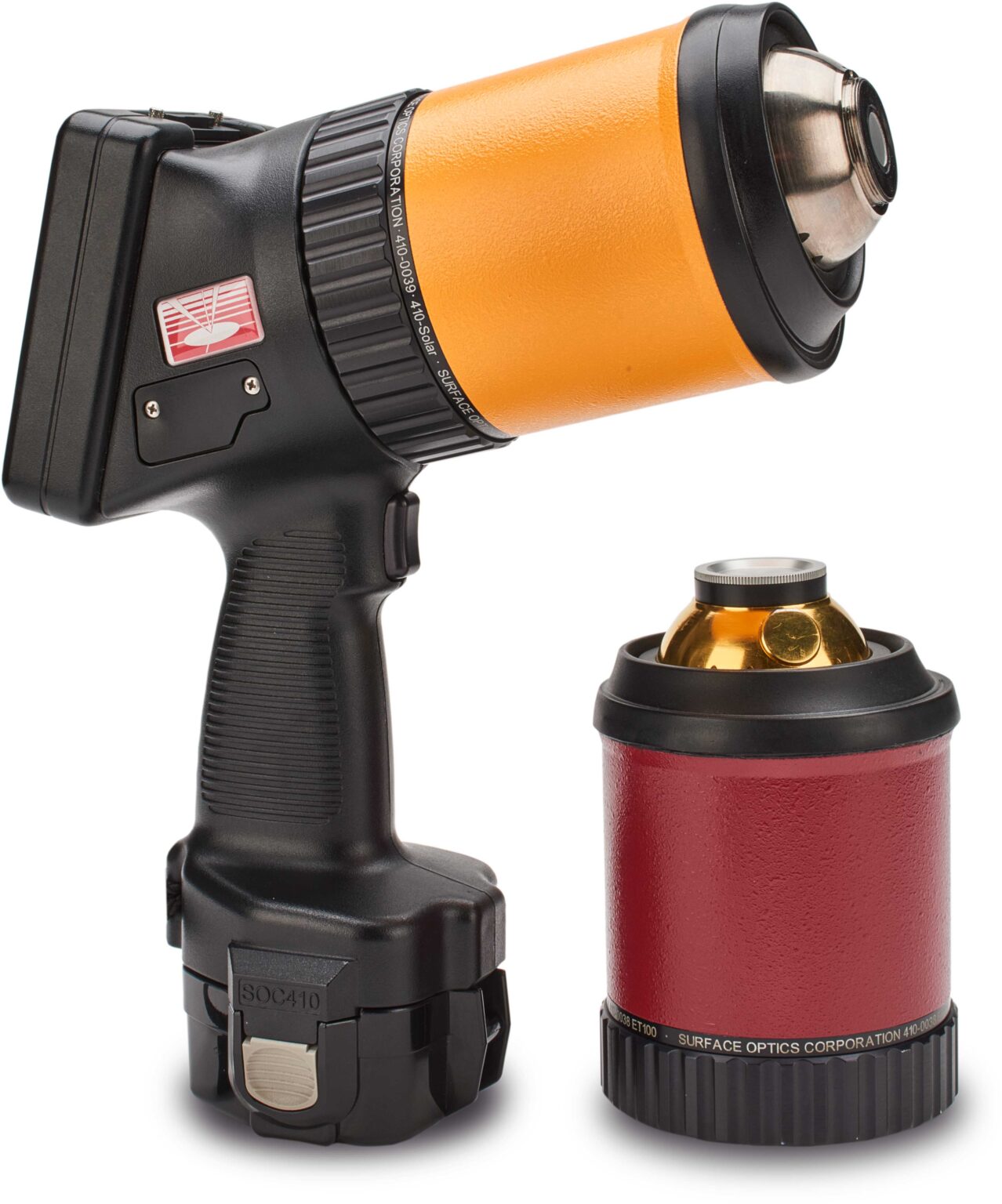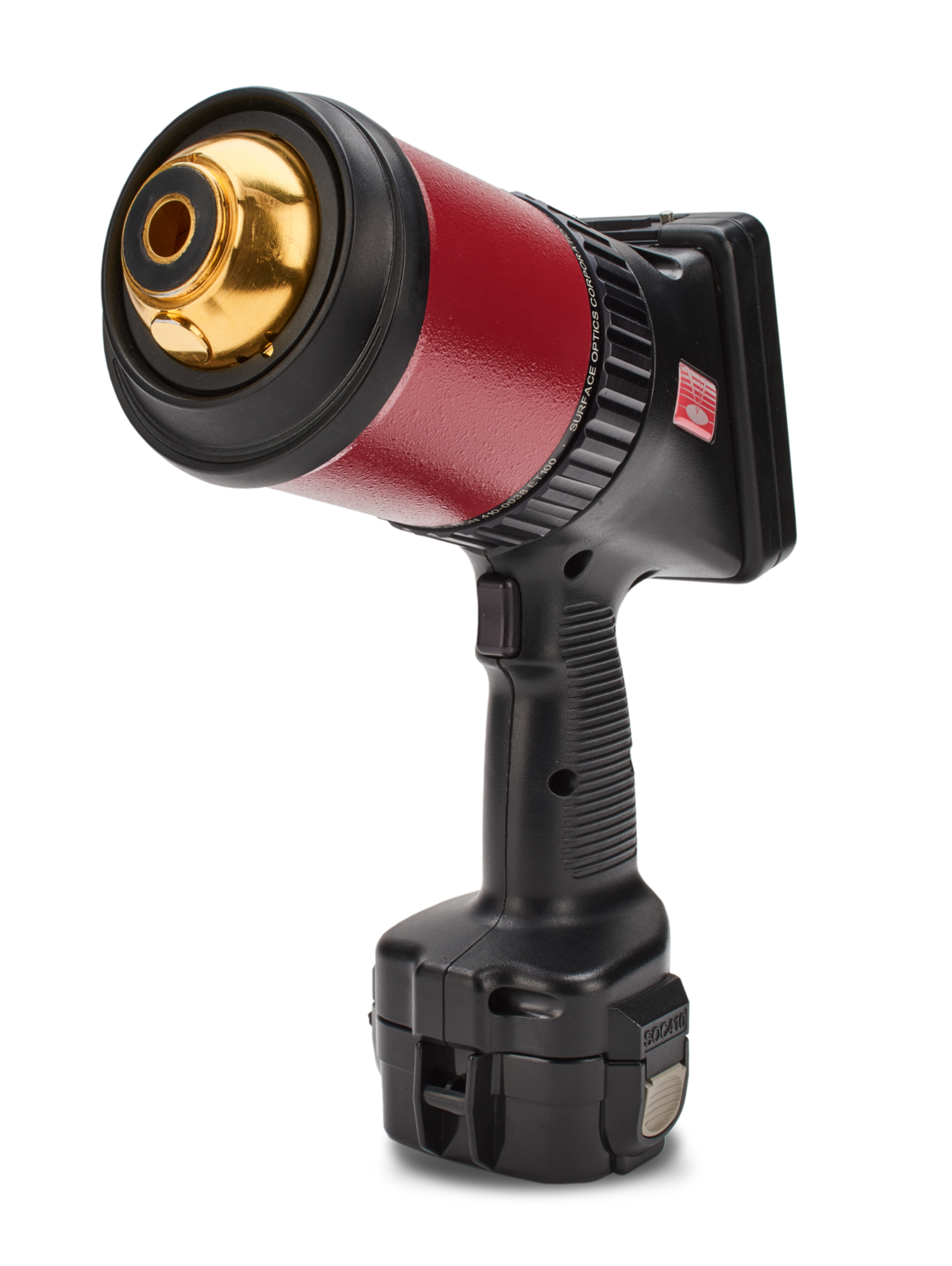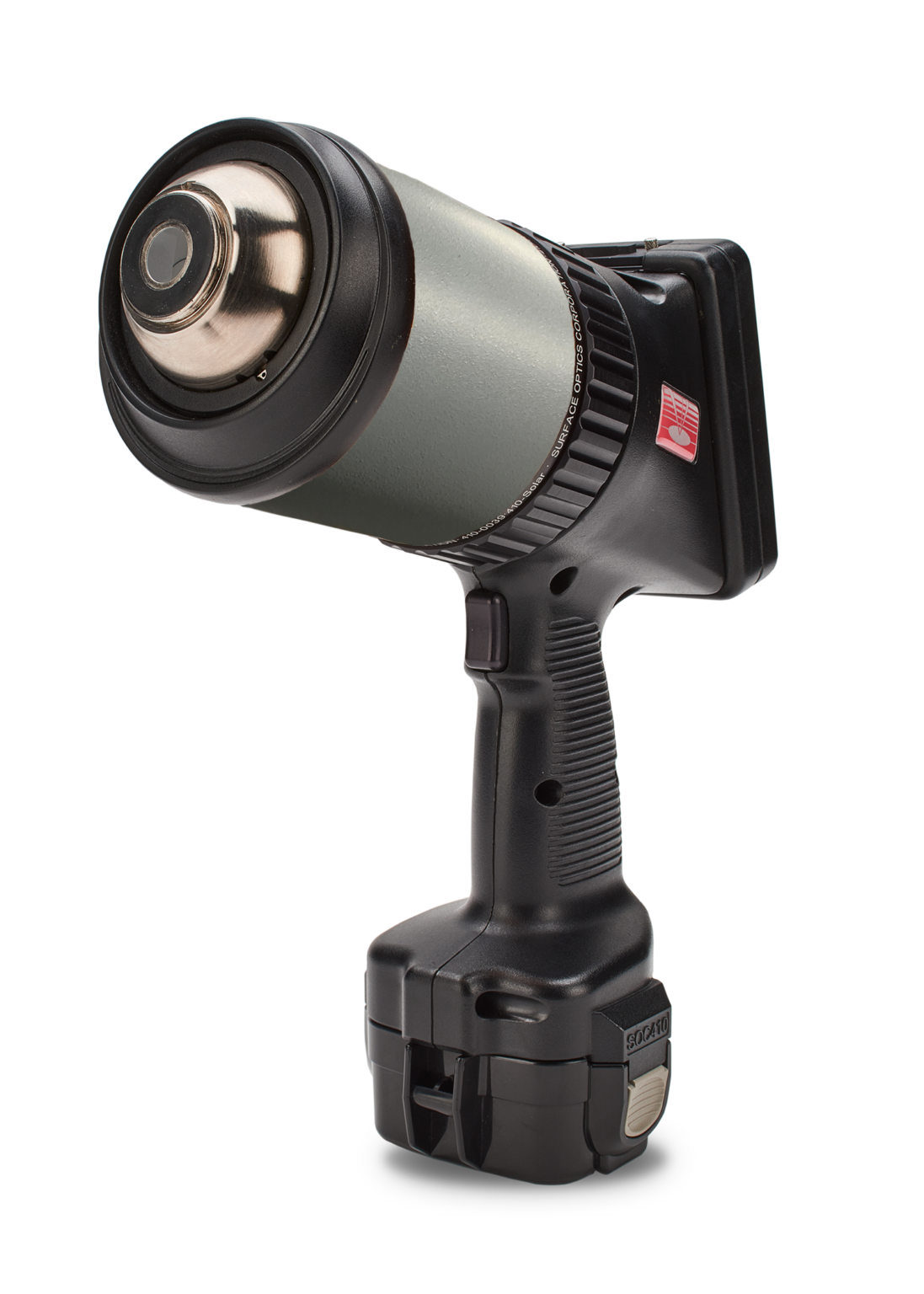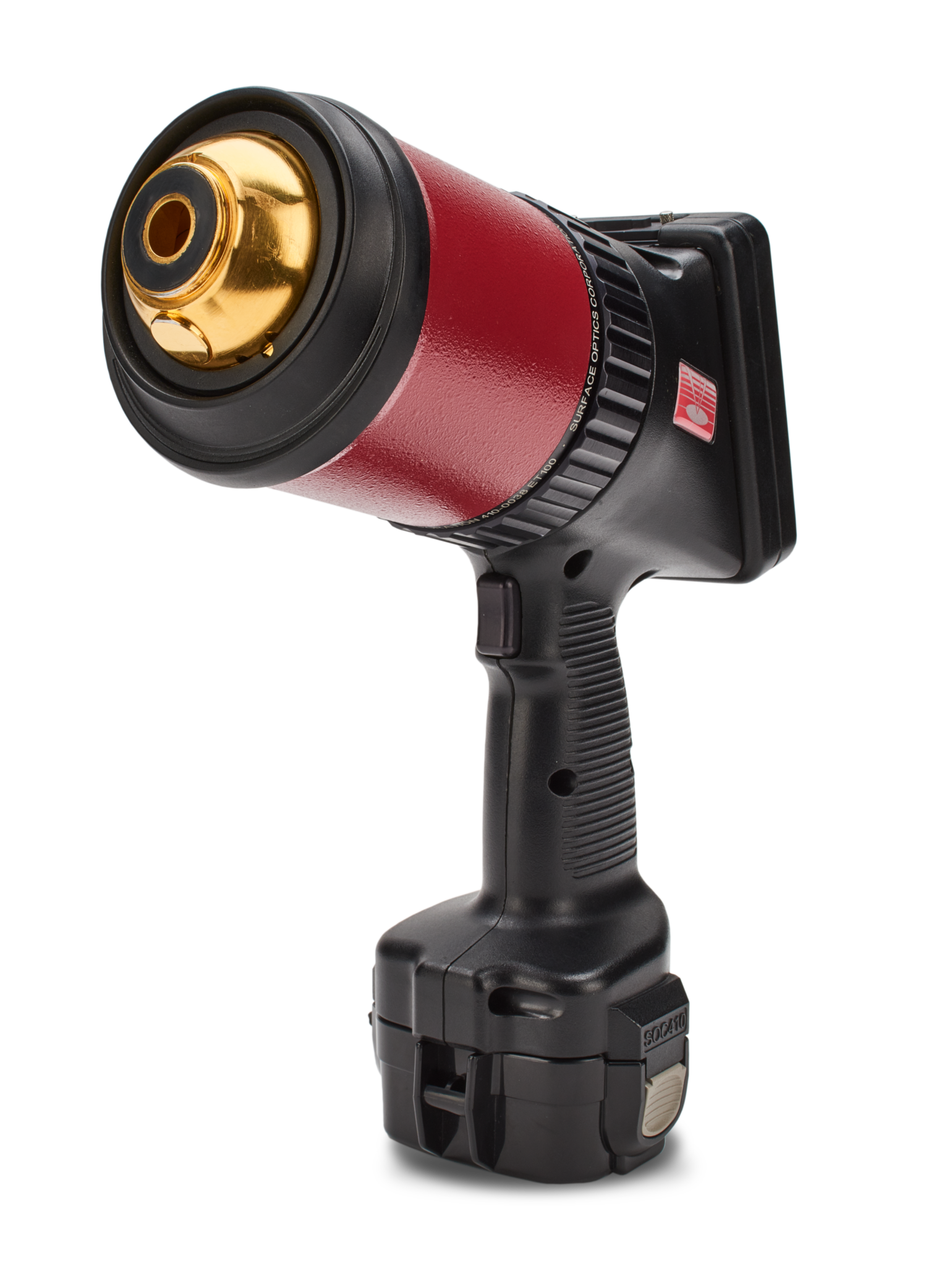
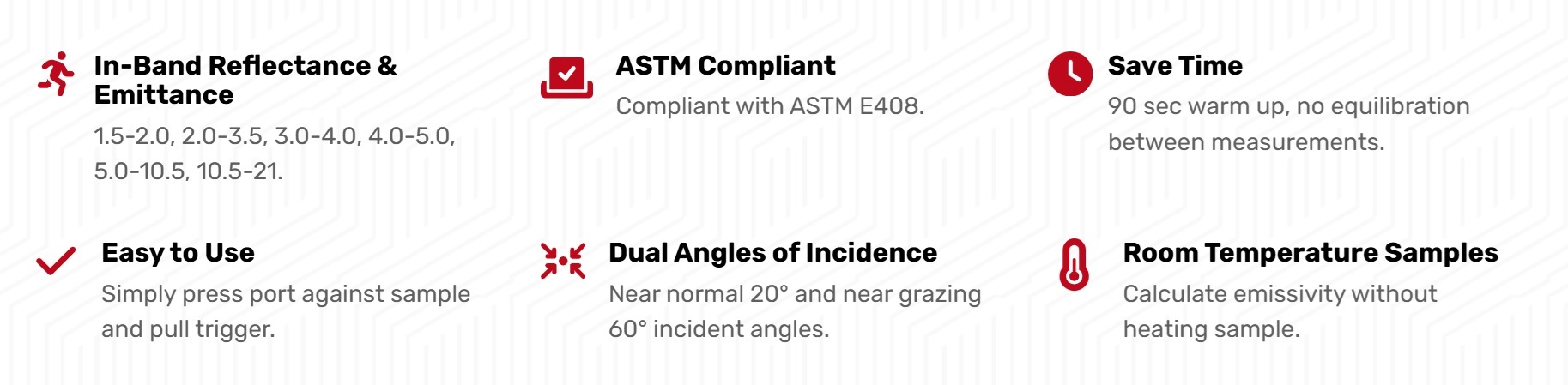
The ET-100 measures directional reflectance from 1.5 to 21 μm and, based on those values, calculates directional and total hemispherical emissivity. The ET-100 emissometer conforms to ASTM E408, the standard test method for the determination of emittance using a portable instrument. In-band reflectance data for six discrete bands.
Characterizing materials for:
|
Measured Parameter |
Directional hemispherical reflectance (DHR) |
|
Method |
Integrated total reflectance in a band for a given angle of incidence |
|
Measured Value |
Absolute reflectance (0-1) |
|
Calculated Value |
Directional thermal emissivity at 20º, directional thermal emissivity at 60º, |
|
Wavelength Bands (microns) |
1.5-2.0, 2.0-3.5, 3.0-4.0, 4.0-5.0, 5.0-10.5, 10.5-21 |
|
Angle of Incidence |
20º & 60º from normal incidence |
|
Calibration Coupon |
Specular Gold |
|
Accuracy |
+/- .03 |
|
Repeatability |
± .005 units |
|
Beam Spot Size |
0.50 inches |
|
Measurement Time |
10 sec |
|
Sample Size & Geometry |
Flat: ≥ 0.5 in. diameter Curved: 6 in. convex; 12 in. concave |
|
Warm Up Time |
90 seconds |
|
Time Between Measurements |
2 seconds |
|
Sample Temperature |
Ambient or heated/cooled to 0 – 100º C |
|
Operating Temp |
0º to 40º C |
|
Storage Temp |
-25º to 70ºC |
|
Run Time |
2 hours on one battery. Battery easily replaced with continuous operation after battery replacement. |
|
Power Source |
Rechargeable battery (standard environmentally friendly NiMH) |
|
Battery Recharge Time |
1 hour |
|
IR Source |
Kanthal filament operated at about 1,000ºC |
|
Weight |
4.7 lb |
|
Form Factor |
H 11.54”, L 9.04”, W 3.27” (29.31 cm x 22.96 cm x 9.44 cm) |
|
Operator Interface |
LCD graphics screen, 1/4 VGA, touch screen, software buttons; trigger switch in handle |
|
Software Applications |
Pass/fail can be incorporated, user set values |
|
Diagnostics |
On screen status and signals monitor. Signal values stored with data. Raw data collection and display. |
|
Data Format |
Data files can be opened and post processed with Excel or a text processor |
|
Data Storage |
Removable SanDisk (SD) card |
|
ASTM Standard |
E903 |
|
Export Control |
ECCN #3A999.F |
Standard ET100 Components
Optional ET100 Components
All three models measure directional hemispherical reflectance (DHR). The 410-DHR and ET10 provide in-band emittance for thir spectral bands using the calculation of one minus reflectance, or E = 1 – DHR. The ET100 uses the DHR to provide in-band emittance values plus a single value for directional emittance at 20 degrees, directional emittance at 60 degrees, and total hemispherical emittance.
The basic property measured by the ET100 is reflectance. Since reflectance is a physical constant, temperature independent, it can be used to determine an accurate emissivity value if the interrogated surface does not undergo a physical or a chemical change between the measurement at ambient temperature and the high temperature. The ET100 measures emissivity of an object at ambient temperature, and the user sets in the instrument the desired higher temperature, and it will calculate emissivity for that temperature.
The metal and dielectric look up tables store values of a correlation factor for a range of Directional Thermal Emissvity (DTE) 20°. This correlation factor defines the relationship between DTE20° and THE and it is different for metals versus dielectrics. DTE20° is measured and multiplied by the correct correlation factor to yield THE. DTE60° is not used in this calculation.
The near normal directional emissivity values are used to derive total total hemispherical emissivity utilizing correlations published Siegel and Howell, Thermal Radiation Heat Transfer, Taylor and Francis, 1992. The ratio of total hemispherical emittance to near-normal directional thermal emittance is plotted as a function of near-normal directional thermal emittance. There is a curve for metals and a curve for dielectrics. These correlations are stored as tables in the ET100 software and used to calculate total hemispherical emittance from the measured near-normal directional thermal emittance. While the ET100 measures directional thermal emissivity at 20 and 60 degrees angle of incidence, only the DTE20° is used to calculate the total hemispherical emissivity.
Test Method C.