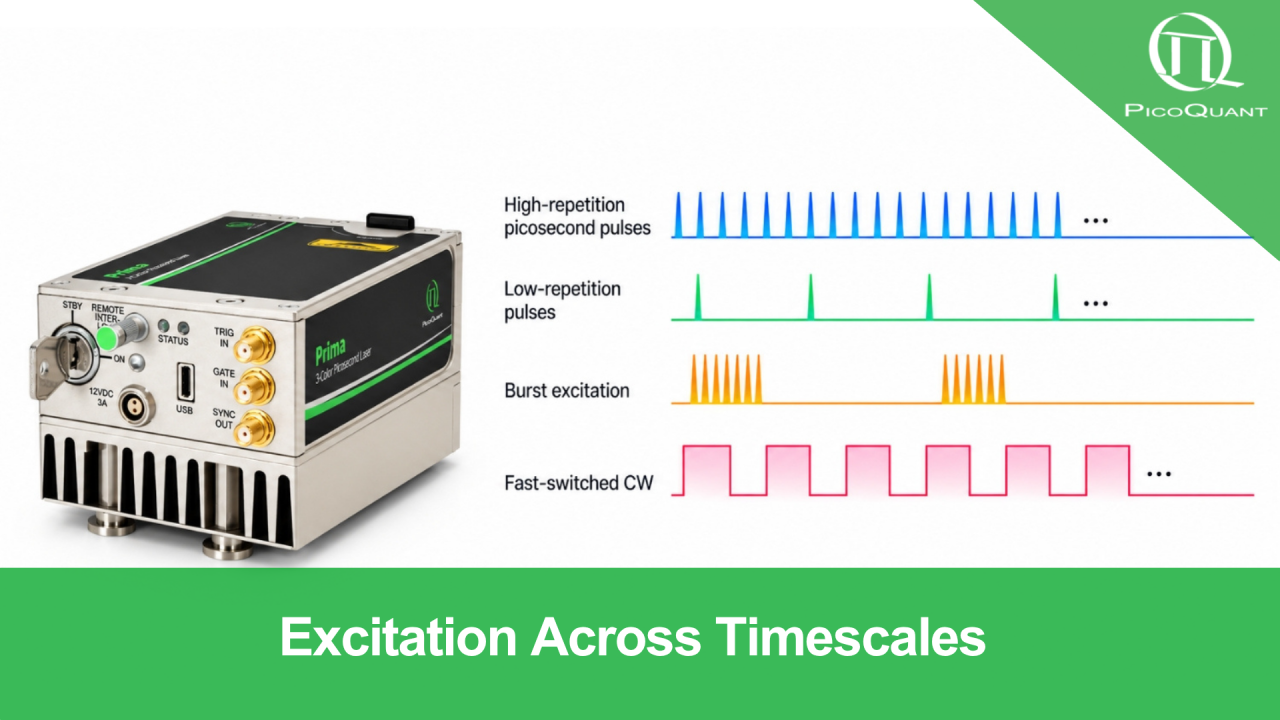
A lifetime measurement begins before the first photon is detected. Whether you are investigating sub-nanosecond fluorescence or much longer-lived emission, the excitation pattern determines the time window in which the dynamics can be observed. A picosecond pulse can provide a well-defined starting point for fast decay measurements. But as emission persists longer, repetition rate and excitation timing become increasingly important.
Peer-reviewed studies illustrate how different excitation conditions can be tailored to the experiment.
In photon-spin-resolved TRPL of MoSe₂ coupled to chiral silicon metasurfaces, Feng Pan et al. used 640 nm excitation at 20 MHz to resolve sub-nanosecond emission dynamics. The measurements revealed polarization-dependent decay and supported the interpretation of valley-selective enhancement of radiative decay.
In a very different application, Wonsang Hwang et al. integrated three Prima wavelengths (450, 520, and 640 nm) at 25 MHz into a high-speed FLIM system. Lifetime contrast allowed immunofluorescence to be separated from overlapping tissue autofluorescence in the phasor domain.
And in quasi-2D perovskites coupled to an aluminum surface-lattice-resonance cavity, Yen Yu Wang et al. used 450 nm excitation at 5 MHz for time-resolved characterization. The lower repetition rate corresponds to 200 ns between excitation pulses, demonstrating yet another timing configuration for probing photophysical dynamics.
Different samples. Different questions. Different excitation conditions. For fast decays, short picosecond pulses provide a defined starting point for lifetime measurements. For longer-lived emission, however, simply repeating excitation pulses at high frequency may not leave enough time to observe the decay. Lower repetition rates can extend the interval between excitation events. Gated excitation can go one step further, creating defined excitation and dark intervals in which delayed emission can be observed.

This is where excitation flexibility becomes important. Prima combines picosecond pulsed and CW operation with repetition rates from 1 kHz to 200 MHz, external triggering, and gated excitation. Depending on the experiment, excitation can be structured as individual pulses, pulse bursts, or defined excitation and dark intervals. And when multiple excitation wavelengths are required, Prima can integrate up to three wavelengths in one stand-alone laser platform, with configurations at 375, 405, 450, 485, 515, and 640 nm.
The key question is not simply how short is the pulse?
It is: Does the excitation pattern match the dynamics you want to observe?
From fast TRPL and FLIM to excitation schemes for longer-lived luminescence, Prima provides the timing and wavelength flexibility to adapt the excitation to the experiment.