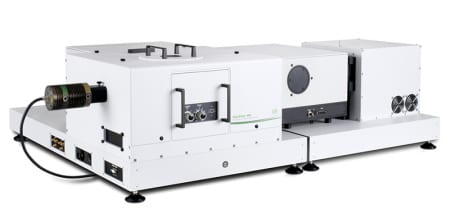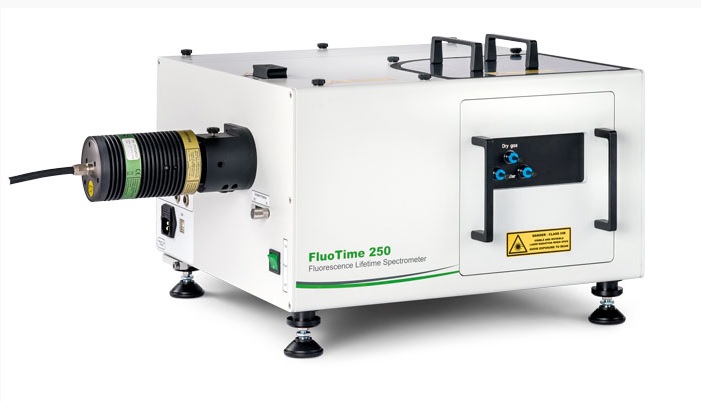
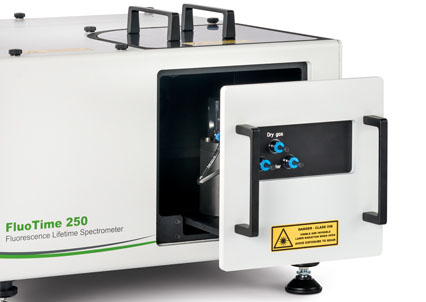
The FluoTime 250 is a compact table-top though flexible lifetime fluorometer for life science, materials science, and photochemistry applications. This setup enables users to carry out routine lab work quickly, reliably and with high precision. Our fully automated setup contains the complete optics and electronics for recording fluorescence and photoluminescence decays by means of Time-Correlated Single Photon Counting (TCSPC) or Multichannel Scaling (MCS) from a few picoseconds to several seconds. FluoTime 250 is filter-based though it can be equipped with an additional monochromator for UV-Vis spectral range. This fluorescence spectrometer offers high spectral and temporal resolution that allow the acquisition and analysis of
FluoTime 250 is designed to be equipped with PicoQuant picosecond pulsed light sources. All components are being controlled by EasyTau 2 software. A unique feature of PicoQuant spectroscopy software are its three operation modes:
The latest version of the software, EasyTau 2.3, supports the integration of Prima and Taiko PDL M1.
| Optical configuration | L-Geometry |
| Mode of operation |
|
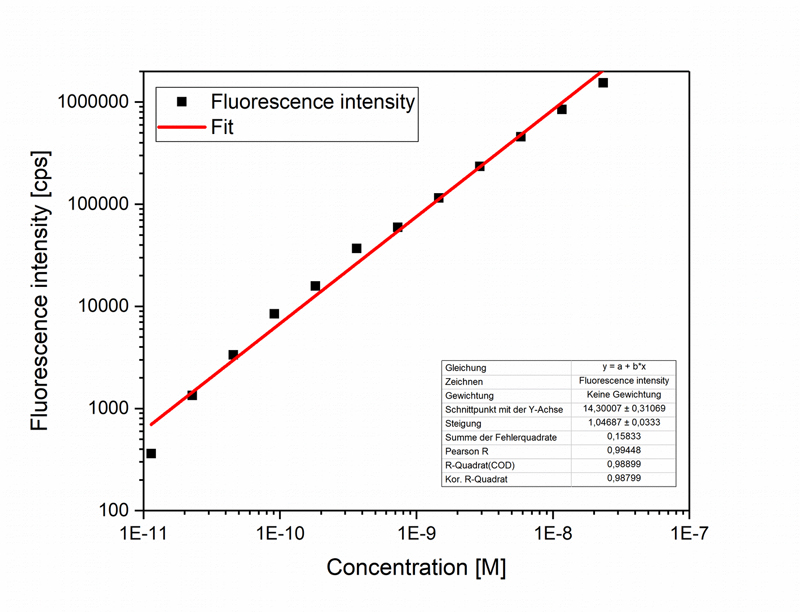
| Sensitivity | Down to 10 pM measured with a coumarin sample, with excitation at 440 nm and emission detected at 495 nm |
| Lifetime range |
Depending on light source and detector choice |
| Excitation sources | 255 – 1200 nm picosecond pulsed light sources with repetition rates up to 80 MHz |
| Optional monochromator |
|
| Detectors |
|
| EasyTau 2 software |
|
All Information given here is reliable to our best knowledge. However, no responsibility is assumed for possible inaccuracies or omissions. Specifications and external appearances are subject to change without notice.
Fluorescence Measurement of Extremely Dilute Samples
Dyes and Fluorophors
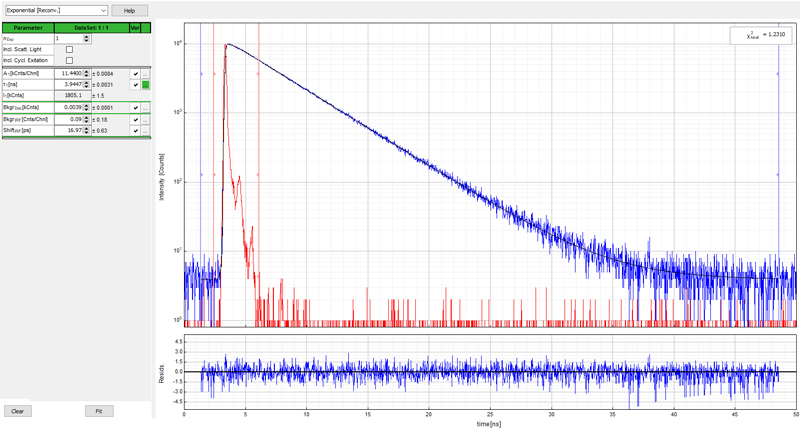
FluoTime 250 is designed for routine lab works and is an optimal setup for fluorescence lifetime measurements of optical probes such as dyes and fluorophores in solution, as powder or thin film.
As an example, the time-resolved emission of ATTO425 and Ru(bpy)3 aqueous solution are shown. The lifetime decays can be well described with single exponential decay function, as expected. The fit results in 3.944 ± 0.003 ns and 513.85 ± 0.35 ns for ATTO425 and Ru(bpy)3, respectively, which fits well with reported lifetime values for these dyes.
The samples have been excited at 418 nm using a LDH-P-C-420 pulsed laser. To acquire the long lifetime decay of Ru(bpy)3, burst mode is applied that is a unique feature of PicoQuant pulsed light sources enabling fast measurements. The collected data is analyzed in the fitting module of the EasyTau 2 using a reconvolution tail fit.
Photocatalysis and Photoelectrocatalysis
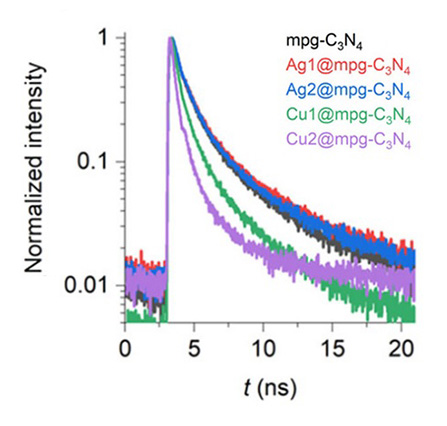
The relation between catalysts texture and their photophysical-photocatalytic properties has been investigated by Liu et al. Employing various methods including transient photoluminescence via FluoTime 250. Time-resolved measurement (TRPL) of single-atom heterogeneous catalysts featuring highly dispersed Ag and Cu on mesoporous graphitic carbon nitride (C3N4) is performed using 365 nm excitation.
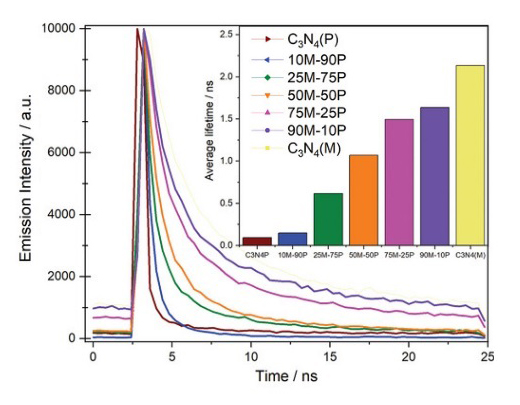
Jerigova et al. applied FluoTime 250 to study sulfur doped carbon nitride (C3N4) as promising material for development of long-range visible catalysts. The transient photoluminescence using 375 nm excitation is acquired from the samples, prepared from various ratio of sulfur-containing precursor, to characterize their physicochemical properties.
Characterization of Lasing and Scintillation materials
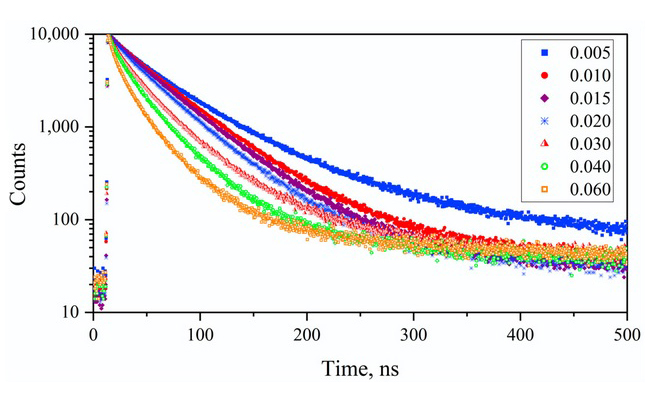
Scintillation materials are being used to detect various ionizing radiation. Korzhik et al. focused on the partial substitution of Gd with Lu ions in the Ce-doped GLAGG crystalline ceramics. They revealed nonequilibrium carriers near various cationic subsystems in the quaternary compound. PicoQuant FluoTime 250 is employed to measure the photoluminescence kinetics using pulsed excitation at 340 and 540 nm. The luminescence was detected at 550 nm with spectral width of 10 nm.
Semiconductors
Red carbon is a polymeric semiconductor synthesized from carbon suboxide (C3O2) for potential application in solar cells or photocatalysis. Odziomek et al. Used FluoTime 250 for spectroscopic analysis of red carbon to determine its chemical structure together with elemnetal analysis methods. Three different samples, namely solution, powder and film are characterized resulting in lifetime values of 1.45 ns, 0.09 ns, and 0.07 ns, respectively.
Images are used, adapted and reproduced under CC By licence of each corresponsing journals.
The following documents are available for download: