
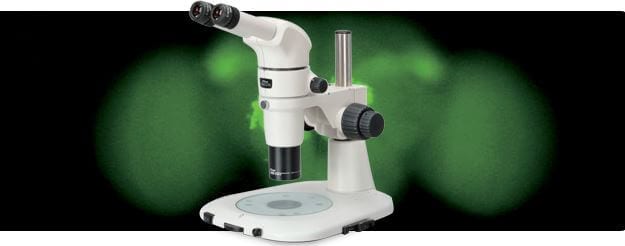
New zoom stereo microscope – Incredible sharpness throughout a wide magnification range.
Continue reading “Nikon Stereo Microscope SMZ1270/ 1270i”
Archives: Product
Nikon Stereo Microscope SMZ25/SMZ18
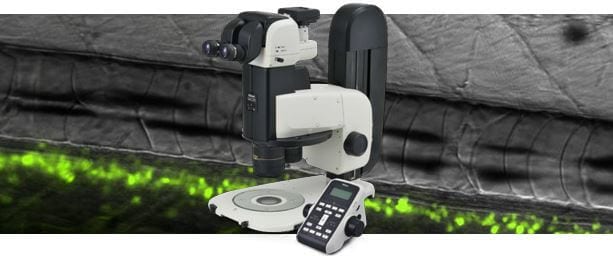
Breakthrough new stereo microscope optics deliver the world’s highest zoom ratio of 25:1, higher resolution and brighter fluorescence images.
Traditional boundaries between scientific fields such as molecular biology and developmental biology are rapidly disappearing as researchers seek to connect findings at the molecular level to those derived from cellular, tissue, and organismal studies. Fields including molecular biology, cell biology, neurobiology, embryology, developmental biology and systems biology have increasing needs for imaging systems that span spatial scales from single cells to whole organisms.
With these demands in mind, Nikon has developed a stereo microscope that features a large zoom ratio of 25:1, high resolution and exceptional fluorescence transmission capability.
Upright Microscope Eclipse Ni Series
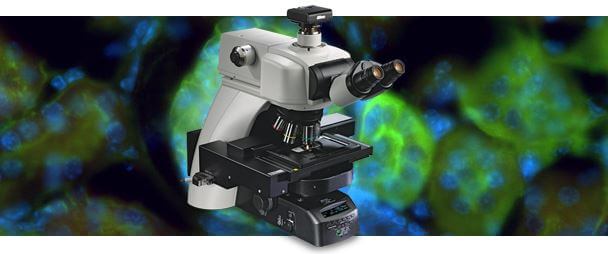
Supports a wide range of applications with outstanding optical performance and flexible system expandability
The ECLIPSE Ni series is Nikon’s flagship upright microscope, boasting great optical performance and high system expandability. Combined with high-performance objectives, it can accurately visualize microstructure of the sample with high resolution. Adopting a stratum structure that allows simultaneous mounting of multiple fluorescence attachments, it provides great flexibility to freely combine various accessories as needed.
The fully motorized model Ni-E, which enables automatic observation, responds to the needs of advanced research in which control of devices such as cameras and confocal systems is linked with microscope control, and supports a wide range of cutting-edge bioscience research.
This product is available for clinical use in the United States. Please contact your local Nikon dealer for information on clinical use of this product in your country.
Upright Microscope Eclipse Ni-U
Highly versatile upright microscope combining system expandability and superior optical performance in an easy-to-use system.
Introducing Nikon’s next generation upright microscope. Optical performance, system expand ability, ease of use. All evolved.
Nikon’s new Ni Series microscopes were developed to address the need for a microscope that is highly versatile, combining system expandability and superior optical performance in an easy-to-use system. The Ni-U can be configured in a multitude of ways depending on the requirements of the user. Its adaptability makes it suitable for many applications, from clinical examination to research, and features motorized accessories that include nosepiece, fluorescence attachment, and shutter.
Clinical Upright Microscope Eclipse Ci Series
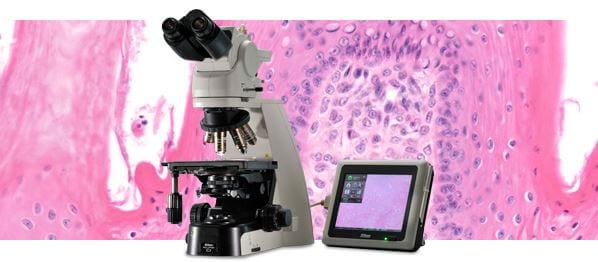
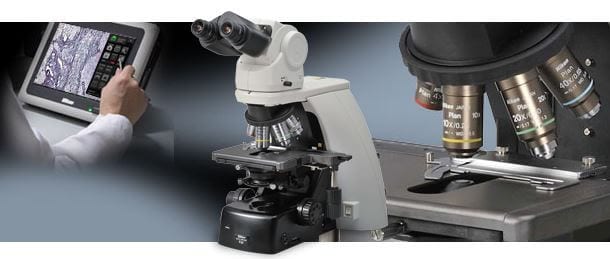
Clinical and laboratory microscopes featuring LED illumination*, providing stress-free operation for routine use
To meet the demands of clinical laboratory specialists and researchers, Nikon has reviewed all aspects of microscope usability to develop the ECLIPSE Ci series of microscopes, which combines superior functionality with operational ease. The Ci is designed to ensure natural posture while viewing images, sample changing and capturing images. Bright, eco-friendly LED illumination reduces the need for frequent lamp replacement*. A variety of accessories are available that support various imaging techniques.
* Halogen model (Ci-S) is also available
Upright Microscope Eclipse FN 1
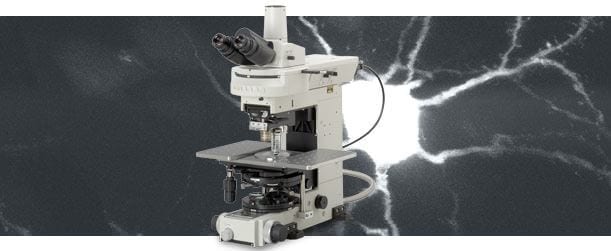
Visualizes minute details within thick specimens with perfect clarity in patch-clamp experiments.
The ECLIPSE FN1, developed especially for electrophysiological research, features enhanced operability to facilitate patch-clamp experiments. Advantages offered by the FN1 include slim body, streamlined structure, improved electrode placement, long working distance, and greater noise reduction. A deeper area of the specimen can be observed clearly with infrared (IR) light.
Upright Microscope Eclipse Si

Focus in comfort. Comfort in focus.
Nikon has designed the ECLIPSE Si to meet the rigorous demands of professionals who spend hours using the microscope. The ECLIPSE Si is ergonomically designed to enhance operational efficiency. This powerful instrument helps you to stay focused for longer by reducing the strain on your body. The ECLIPSE Si is the new standard in microscopes, expanding the possibilities of exploring the micro world.
Upright Microscope Eclipse Ei

Look into the future
Curiosity – the genuine desire to study the world and unlock its mysteries – is the starting point of science and technology.
The ECLIPSE Ei educational microscope offers unique digital and design solutions to ensure the smooth progress of your courses. Using the ECLIPSE Ei to foster your students’ curiosity and maintain their enthusiasm for learning, you can unlock their potential and open their eyes to the world around them.
Nikon Smart Imaging System Eclipse Ji

Research Microscope Power in a Benchtop Assay Instrument
Simple Operation
Minimal experimental setup and complexity by AI-driven assays and analysis.
Easy Cellular Imaging
No need to master complicated microscope hardware and software – ECLIPSE Ji makes data collection and cellular imaging assays easy.
High Quality Optics
Renowned Nikon optics provide clear and sharp images on plate assay devices.
Inverted Research Microscope Eclipse Ts2R
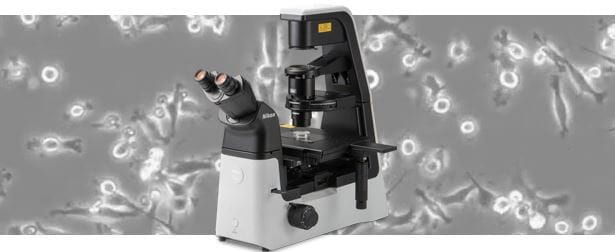
A compact inverted research microscope configurable with a wide variety of observation methods
A new intermediate-sized inverted research microscope designed for a wide variety of applications. Do more than before!
Using these innovative optics and a fly-eye lens, crystal clear fluorescent images with improved S/N ratios are possible, even in low-excitation light applications such as cell division. Additionally, even at low magnifications, the SMZ25 microscope has a 35mm F.O.V, allowing users to capture an entire 35mm dish with uniform brightness.
The Eclipse Ts2R is a compact inverted research microscope that is configurable with a wide variety of observation methods. The broad range of observation methods, smaller body and improved ease of use will directly benefit research laboratories and improve workflow.
In addition to conventional contrast methods, the Eclipse Ts2R features versatile observation methods, including Phase Contrast, DIC, Hoffman Modulation Contrast and Emboss Contrast. It is also compatible with a selection of high performance and quality optical accessories to function similarly to the inverted research microscope Eclipse Ti and produce clear, sharp images.