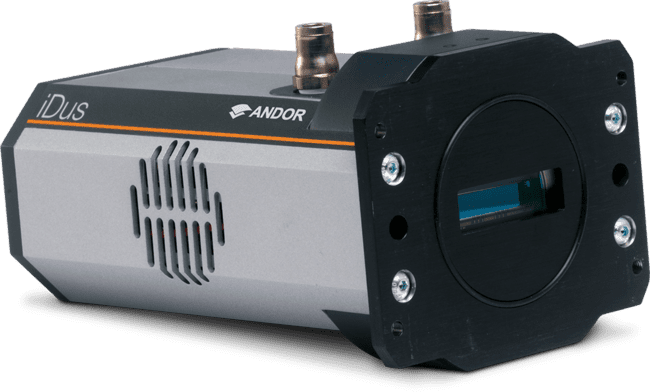
iDus spectroscopy CCD Camera is designed with the lowest noise to provide an ultra sensitive and high dynamic range detector for use in a wide range of both conventional and demanding spectroscopic applications. iDus offer a wide range of different format sensors to optimize the detector for your specific application.
The scientific grade, 1024 x 255 high speed spectroscopy CCD camera is ideally suited to rapid analysis, multi-channel and low-light applications including fluorescence and Raman spectroscopy. The 420’s range of Front (Open Electrode) and Back Illuminated and Deep Depletion sensor options provide optimised performance from UV through Visible to Near IR.
- Peak QE of 95%
- TE cooling to -100°C
- UltraVac™
- Single window design
- 26 x 26 μm pixel size
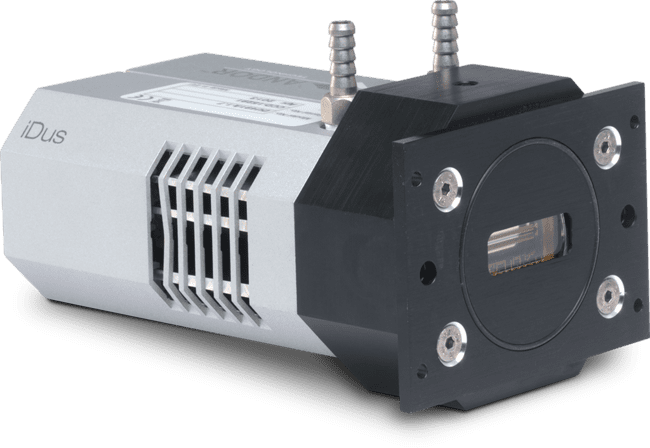
iDus spectroscopy CCD Camera is designed with the lowest noise to provide an ultra sensitive and high dynamic range detector for use in a wide range of both conventional and demanding spectroscopic applications. iDus offer a wide range of different format sensors to optimize the detector for your specific application.
Andor’s new iDus 416 platform boasts a unique combination of very low dark noise and very high QE, offering unrivalled sensitivity in the near-infrared. This makes it the ideal detector for NIR Raman and Photoluminescence, reducing greatly acquisition times and removing the need for inconvenient LN2 cooling.
- Low dark current
- Peak QE up to 95%
- 30 mm wide sensor
- TE cooling down to -95ºC
- 15 µm pixels
iDus spectroscopy CCD Camera is designed with the lowest noise to provide an ultra sensitive and high dynamic range detector for use in a wide range of both conventional and demanding spectroscopic applications. iDus offer a wide range of different format sensors to optimize the detector for your specific application.
The Scientific Grade, 1024 x 127 deep depletion spectroscopy CCD camera is ideally suited to rapid analysis, multi-channel and low-light applications including fluorescence and Raman spectroscopy. The 401’s range of Front and Back Illuminated and Deep Depletion sensor options provide optimised performance from UV through Visible to Near IR.
- Peak QE of 95%
- TE cooling to -100°C
- UltraVac™
- Single window design
- Fringe suppression technology
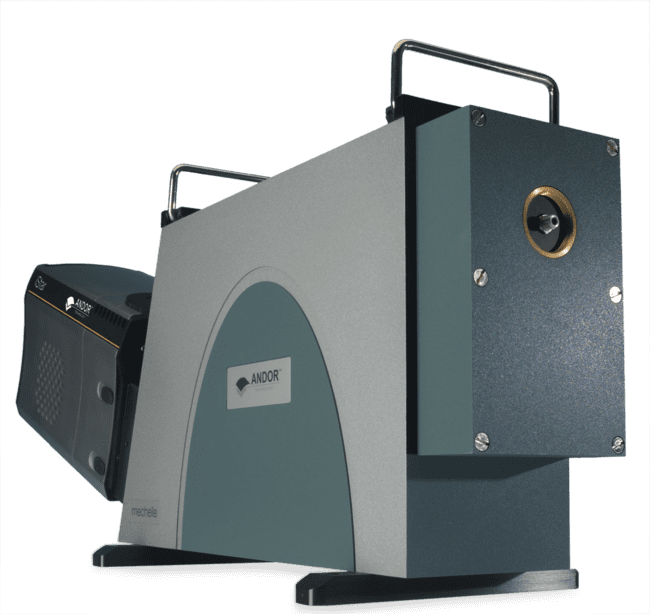
Andor’s new Mechelle ME5000 Echelle spectrograph has been designed to provide simultaneous recording of a wide wavelength range (200-975 nm) in one acquisition. It has no moving components is available in a pre-aligned detector/spectrometer format. The Andor Mechelle spectrograph is based on the echelle grating principal and its patented optical design provides extremely low cross-talk and maximum resolution compared with other spectrographs.
- Compact and robust design
- Patented optical design
- Auto-temperature correction
- N2 purged
- Pre-aligned detector/spectrograph
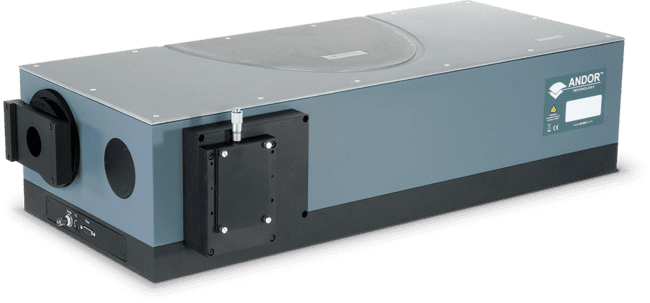
The Andor Shamrock SR-750 is based on Czerny-Turner optical design. The Shamrock is available as a pre-aligned detector/spectrometer option allowing for seamless integration of software, electronics, optics and detector. There is also a fast and interactive graphical software interface allowing full control of all the spectrograph functions.
The Shamrock 750 offers the highest resolution of the Shamrock family, but is also well suited for applications requiring multi-track capabilities.
This rugged platform features a comprehensive range of light coupling accessories and gratings, and combines ideally with Andor’s market leading CCD, Electron Multiplying CCDs, InGaAs and Intensified CCDs. Andor’s latest addition of single point detectors for scanning monochromator applications up to the LWIR (12 ?m) enhances even further the capabilities of this system.
State-of-the-art Solis Spectroscopy and Solis Scanning software offer a dedicated and intuitive interfaces for spectrograph, detectors and motorized accessory control as well as easy detection parameter set-up.
- Pre-aligned, pre-calibrated detector & spectrograph
- USB 2.0 interface
- Motorized, indexed triple grating turret
- Dual detector outputs
- Multi-track enhanced option
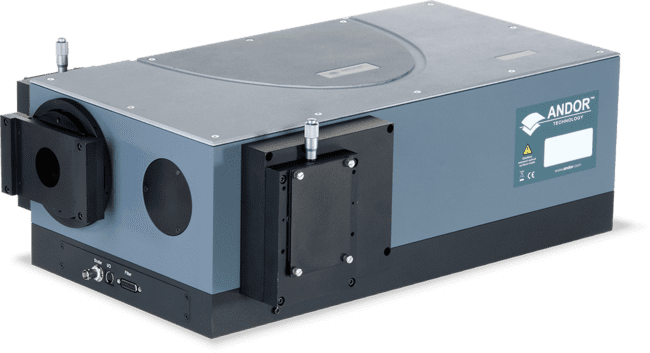
The Andor Shamrock SR-500i imaging spectrometer is based on Czerny-Turner optical design. The optimized optical design provides exceptional performance for multi-track Spectroscopy.The Shamrock 500i is available as a pre-aligned, pre-calibrated camera/spectrometer detection solution allowing for seamless integration in user set-up.
The Shamrock 500i is available as a pre-aligned, pre-calibrated camera/spectrometer detection solution allowing for seamless integration in user set-up. The Spectroscopy-dedicated software interface provides an interactive and intuitive platform for simultaneous detector(s) and spectrometer real-time control.
- Pre-aligned, pre-calibrated spectrograph
- Image astigmatism correction
- USB 2.0 interface
- Motorized, indexed triple grating turret
- Dual detector outputs
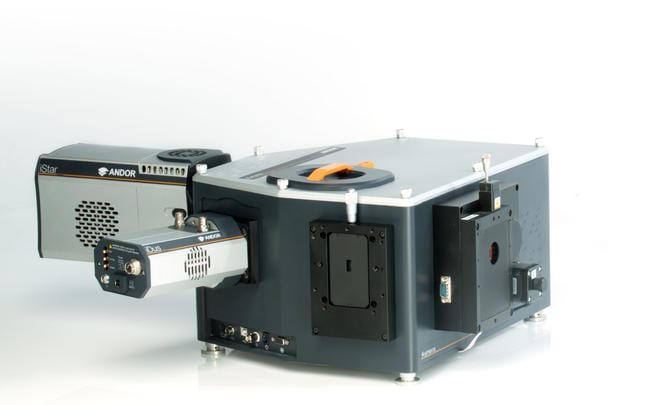
Intelligent and multi-modal spectroscopy platform for Physical and Life science
This highly modular spectrograph features patented Adaptive Focus, quadruple on-axis grating turret and TruRes™ technology, delivering superb spectral resolution performance. The unmatched configurability and highly intuitive user interface make it the perfect platform for a wide range of routine and more advanced spectroscopy experiments.
The intelligent, motorised Adaptive Focus of the Kymera allows automated access to the best optical performance for any grating, camera or wavelength range configuration. The TruResTM option delivers unmatched spectral resolution for a third-meter focal length spectrograph, with performance enhancements exceeding 30%, extracting the very best performance from the Kymera without the need for a grating change or post-processing spectra mathematical alterations. Greater definition of dense Raman or plasma optical signatures can be achieved without compromise on bandpass, from UV to SWIR, at the touch of a button.
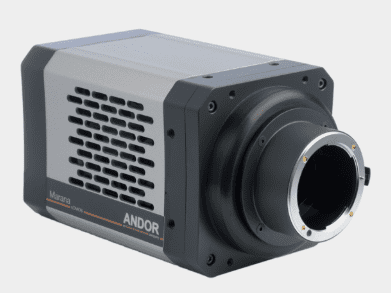
sCMOS Camera for Astronomy and Physical Sciences
Marana is Andor’s latest high performance sCMOS camera platform, ideal for diverse applications within the physical sciences such as astronomy, Bose Einstein Condensation, quantum optics, hyperspectral imaging, neutron tomography and fast spectroscopy. It launches with the large field of view Marana 4.2B-11 back-illuminated sCMOS model, featuring 95% Quantum Efficiency (QE), market-leadingvacuum cooling to -45 °C and 11 µm pixel for optimal photon collection. The large 32 mm diagonal sensor, coupled with rapid frame rate capability, renders the camera ideal for space debris tracking and Near Earth Object (NEO) detection.
Andor’s unique capability to deliver the ultimate in sCMOS sensitivity means signal to noise can be optimized under light starved conditions, ideal for tracking smaller orbital objects, spectroscopic detection of trace concentrations and BEC fluorescence detection of discrete numbers of atoms/ions. Higher sensitivity also means that exposure times can be shortened, facilitating faster frame rate measurements of dynamic processes, complimented by 48 fps frame rate. Marana 4.2B-11 comes with a choice of QE profiles, the UV enhanced option (‘BU’) extending usefulness towards specific application requirements between 260nm and 400nm. The innovative ‘dual-amplifier’ approach to extended dynamic range is ideal for accurately visualizing and quantifying challenging scenes that have both extremely weak and bright regions, such as solar measurements and spectroscopic materials characterisations. Furthermore, to achieve best-in-class quantification accuracy, Andor have implemented enhanced on-head intelligence to deliver market-leading linearity of > 99.7% across the whole dynamic range, ideal for accurate photometry.
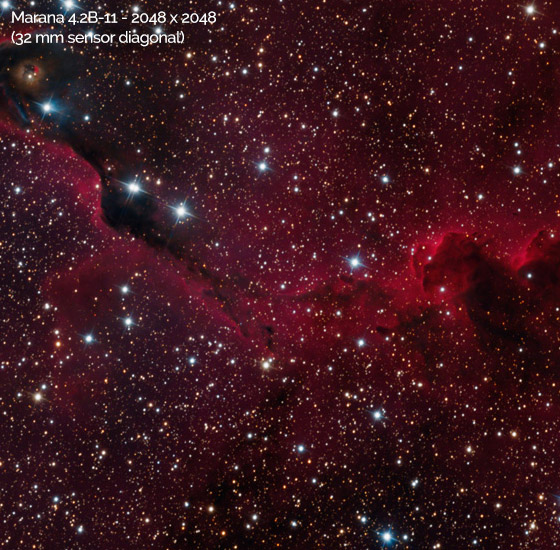

Marana 4.2B-11 utilizes a unique Anti-Glow Technology approach that enables one to usefully access the entire 2048 x 2048 array, offering an impressive 32mm sensor diagonal, which in combination with fast frame rates renders the camera ideal for large sky scanning astronomy. It is also ideal for dense multi-fiber hyperspectral applications. The Marana platform can be readily adapted to Adaptive Optics wavefront sensing. Not only is it capable of producing hundreds of fps with ROIs, it is also specifically architected to minimize data transfer lag.
Marana 4.2B-11 comes with F-mount attachment as standard, however for maximum flexibility Andor can also provide an optional C-mount adapter that is readily exchangeable by the user, usable with ROI sizes up to 1400 x 1400 (2 Megapixel). For attachment to various low f/# professional telescope configurations, Andor’s Customer Special Request (CSR) service can provide custom mount faceplates tailored to your specific optical needs.
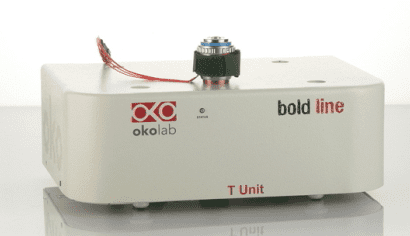
Microscope Objective Heater – stand alone controller
When should I use an Objective Heater
You should use an objective heater, if you:
- Perform Oil Immersion Imaging with a Top Stage Incubator
- Use dipping lens with an upright Top Stage Incubator
Why should I use an Objective Heater?
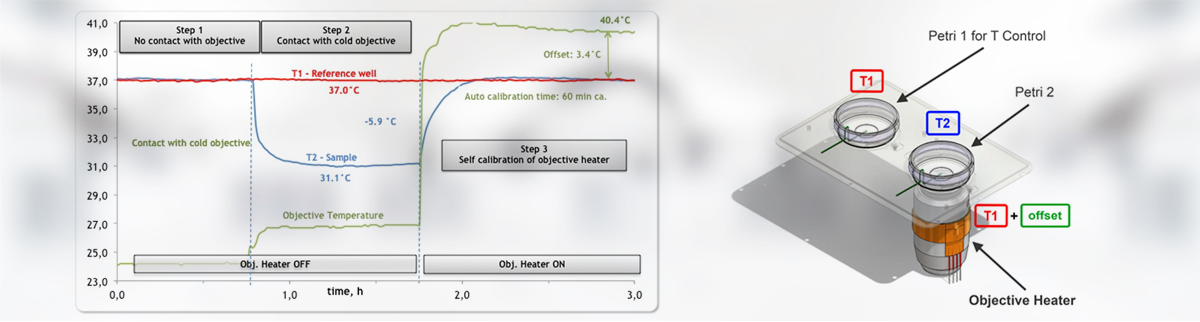
Because, if you don’t, sample temperature will drop due to oil contact with the cold objective, as shown in the following graph.
Step 1: Objective not in contact with Petri 2; Objective Heater Off.
Step 2: Objective in oil contact with Petri 2; Objective Heater Off.
Step 3: Objective in oil contact with Petri 2; Objective Heater on, Offset value 5.3°C.
During the self calibration routine, the offset value of the objective heater is progressively increased, until T2 reaches the desired set point temperature of 37.0°C.
Figure 3 reports the profile of T1, T2, and of Objective Heater Temperature during the experimental campaign described above.